Every school in India is running on software that was never designed for schools.
Every educational institution starts with the best intentions, but over time software stacks become a patchwork of disconnected tools—Tally for accounts, spreadsheets for records, separate apps for at
Every school in India is running on software that was never designed for schools.
That sounds like an exaggeration until you sit in a principal’s office during fee season. There is a portal for collections, bought in a hurry three years ago. There is a learning platform added during the pandemic and never fully adopted. There is Tally, because the accountant knows Tally and always has. There is a biometric attendance machine whose data nobody has exported since March. And underneath all of it, holding the institution together, there are spreadsheets.
Nobody chose this. It accumulated.
We built Unity because we kept meeting institutions living inside that accumulation and because one of them asked us to fix it properly rather than add a ninth tool to the pile.
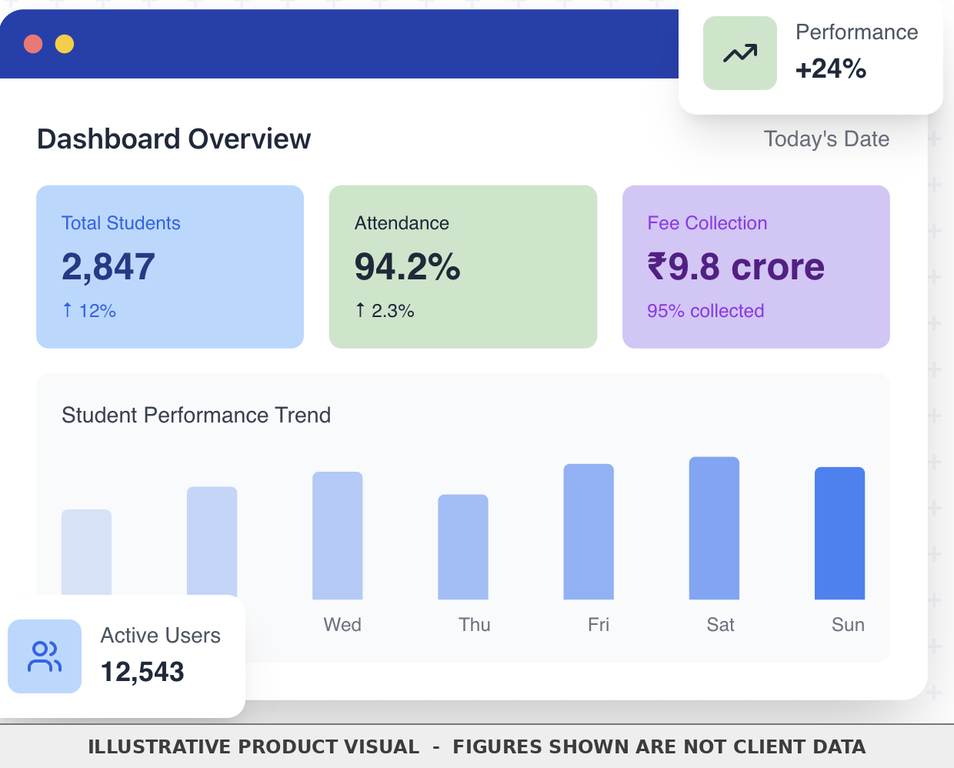
Unity: one dashboard across students, attendance and fee collection. Built and backed by Hybrowlabs.
Why: The Problem Nobody Had Solved
Hybrowlabs has been implementing ERPNext since 2016 across manufacturing, healthcare, trading and nonprofits. Education was different, and it took us a while to understand why.
In a factory, the ERP lives with a defined set of users. Production planners use it. Stores use it. Accounts use it. The shop floor mostly does not need to.
A school has no such boundary. The people who generate the data are teachers between two classes; admission staff answering a parent on WhatsApp; an accountant during the one week a term when most collections arrive; and support staff who have never opened business software in their lives. If any one of those groups cannot use the system, the data is incomplete, and incomplete data in an institution is worse than no system at all because it looks authoritative and is not.
That is the constraint that breaks most school management software. It is built for the office. Schools are not offices.
The second problem is structural. Education software in India is overwhelmingly sold per student. It is a pricing model that works beautifully for the vendor and punishes the institution for the exact thing the institution exists to do, which is enrol more children. Every school we spoke to had done the arithmetic and quietly resented it.
The third is compliance. UDISE+ entries, NEP alignment, and CBSE requirements. In most systems these surface once a year as a reporting scramble, handled by whoever is least able to refuse. They are treated as an export problem. They are actually a workflow problem, and they have to be solved where the data is created.
How: Building It, Not Theorising About It
Unity did not start as a product roadmap. It started as an ERPNext implementation for a group of CBSE schools in Pune, brought to us by Nikhil Karkare, a software engineer who also runs schools and who had lived every problem above from the inside.
That origin matters more than any feature list. We were not designing for a hypothetical institution. We were replacing systems that real teachers were fighting with, on a live campus, during a live academic year. Schools do not have a quiet quarter. Admissions, examinations, fee cycles and payroll continue regardless of what is happening to the software underneath them.
We chose to build on ERPNext and the Frappe framework, and that decision shaped everything that followed.
One data model, not five integrations. The alternative approach, the one most edtech vendors take, is to build a fee module and integrate it with an LMS and integrate that with an HR tool. Every integration is a seam, and every seam is where data goes wrong. Building on ERPNext, admissions, academics, fees, HR, payroll and accounting shared one database from day one. A student is entered once and exists once. Reconciliation between systems disappeared, because there were no longer separate systems to reconcile.
The interface had to reach the gate, not the office door. We built the platform as a progressive web app. A teacher marks attendance on a phone. An accountant works on a desktop. A parent checks fees on whatever device is in their hand. No app store, no installation, no separate mobile interface to learn. This sounds like a small decision. It was the difference between adoption and abandonment.
Admission enquiries had to be caught where parents actually are. So we built a WhatsApp-integrated CRM, connecting the enquiry directly into the admission workflow, with no handover between tools and nothing going cold in an inbox.
Fees had to run themselves. Automated fee management with integrated payment gateways, receipts generated automatically, and every transaction posting straight into the accounting ledger without anyone rekeying it.
Compliance had to live in the daily workflow. UDISE+ and CBSE requirements built into normal operation rather than bolted on in March.
The migration was completed within one year, across live schools, without interrupting an academic session.
Watch - Unity in action
[[YOUTUBE_VIDEO:R4Wk67DnImk]]
The Moment It Stopped Being a Project
There is a sentence from that implementation we think about often. Nikhil described the transition like this:
"Unbelievably smooth journey. From watchmen to management, everyone uses Frappe."
Nikhil Karkare, Co-founder, Unity
Read that again, because it is not the compliment it first appears to be. It is a technical result.
Enterprise software usually stops at the office door. Here it reached the gate. And when an entire institution operates on one system, from the security desk to the trustee board, something changes that no feature list captures. The data is finally complete. For the first time, leadership is looking at what is actually happening in the institution rather than at what four separate exports suggest might be happening.
That is when we understood what we had built.
The platform designed for a handful of schools in Pune was general enough to run a college. Then a university. Then a group of campuses sharing faculty across locations, with all the timetabling complexity that implies. The problems were not specific to those schools. They were specific to education.
So we stopped treating it as an implementation and started treating it as a product.
What: Unity Today
Unity is an education ERP that runs the full academic lifecycle, from the first admission enquiry to alumni records, for schools, colleges, universities and multi-campus groups.
It is built and backed by Hybrowlabs.
What is in it
- Student information and academics. Student lifecycle management from admission to alumni, digital records, admission workflows, attendance, examination management, curriculum and timetable planning, performance analytics.
- Automated fee management. Online collection across multiple payment gateways, fee structures across programmes and terms, receipts, defaulter tracking, reconciliation into the ledger.
- Learning management. Online classes, digital assignments, assessments, and per-student progress tracking built on Frappe LMS.
- HR and payroll. The complete Frappe HRMS across the employee lifecycle for teaching and non-teaching staff.
- Finance and accounting. General ledger, receivables and payables, bank reconciliation, institutional financial reporting.
- CRM and communication. WhatsApp integrated admission enquiries and parent communication.
- Timetabling and scheduling. Electives, teacher loads, room utilisation, including faculty shared across campuses.
- Multi-campus architecture. Centralised control, cross-campus analytics, and resource sharing.
- Compliance. NEP guidelines, UDISE+ reporting, and CBSE norms are built into the workflow.
IMAGE SLOT: Unity modules overview or feature grid, captured from unityedu.ai
Alt text: Unity education ERP modules covering admissions, fees, academics, HR and finance
Caption: One platform. The whole institution.
What is deliberately not in it
- No per student charges. Unity is your own ERP, priced so that growing your institution does not increase what you pay to run it.
- No vendor lock-in. Unity is built on ERPNext and the Frappe framework, both open source. The system is yours. The data is yours. If you ever want to take it somewhere else, you can.
Why This Matters to Your Institution
Every school that has been burnt by school software asks the same question, and it is the right question: what happens to this in three years?
Unity is not a side project or a reseller badge. We built the platform. We continue to build it. We support the institutions running on it. Behind it is Hybrowlabs, an official Frappe partner delivering ERPNext implementation for schools, colleges and universities will be with the same engineering teams that handle enterprise ERP work across manufacturing, healthcare and finance.
That means an institution adopting Unity gets a product with real engineering behind it and a partner who is still there after go-live. Not a licence and a support ticket queue.
If your institution is running on Tally, spreadsheets and a handful of disconnected tools, we have moved organisations exactly like yours onto a single unified system without disrupting an academic year.
See Unity running against your institution's reality
Unity is built and backed by Hybrowlabs Technologies, an official Frappe partner.
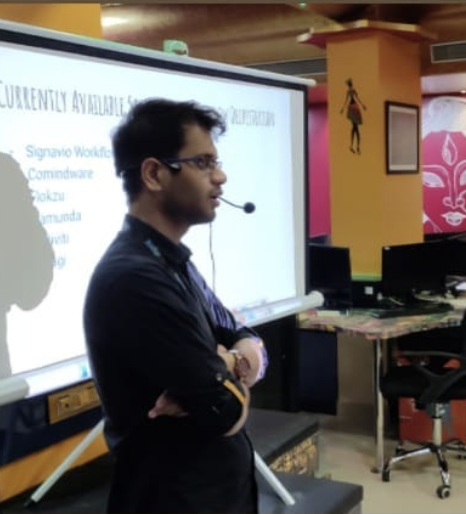
Chinmay Kulkarni
Hi, thanks for coming here. I am the director of Hybrowlabs Technologies, a web, and mobile development studio based out of Pune, India. Leading passionate full-stack developer team to build great mobile and web app experiences. We love to build beautiful apps, would probably keep doing it all my life 😅
No comments yet. Login to start a new discussion Start a new discussion